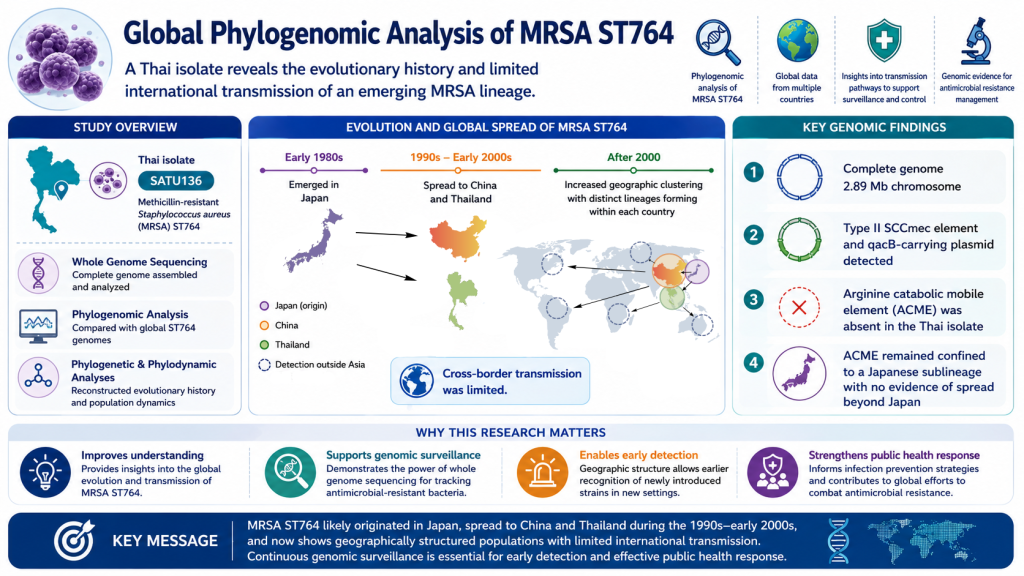
Phylogenomic analysis of a methicillin-resistant Staphylococcus aureus ST764 isolate from Thailand in global context reveals limited cross-border
Key Findings
Revealed the evolutionary origin of MRSA ST764. Phylogenomic analysis suggests that the ST764 lineage most likely emerged in Japan in the early 1980s before spreading to China and Thailand.
Identified limited international transmission. Although ST764 was introduced into multiple countries, its transmission has remained largely geographically restricted, with distinct lineages established within individual countries.
Characterized the Thai ST764 isolate. The Thai isolate (SATU136) carries a type II SCCmec element and a qacB-harboring plasmid but lacks the arginine catabolic mobile element (ACME), distinguishing it from a Japanese sublineage.
Demonstrated the value of genomic surveillance. Whole-genome sequencing and phylogenomic analyses provide powerful tools for tracking the evolution and global dissemination of antimicrobial-resistant pathogens.
Supported public health preparedness. The geographically structured distribution of ST764 creates opportunities for early detection of newly introduced strains, enabling more effective surveillance, infection prevention, and antimicrobial resistance control.